Table of Contents
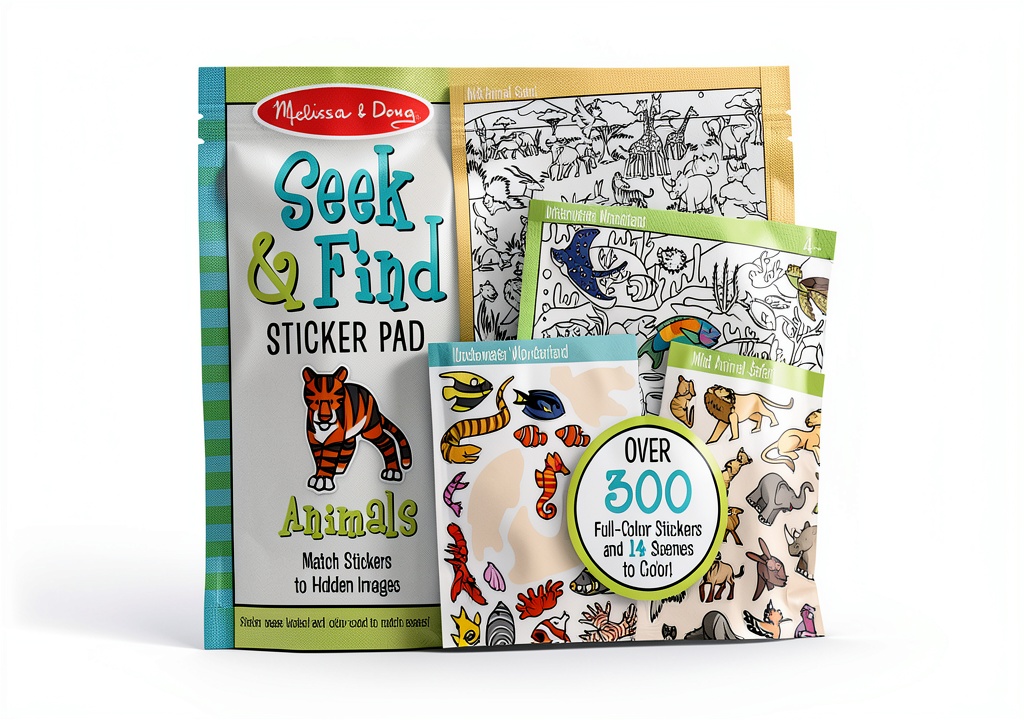
You’re staring at the overflowing toy bin, wondering if there’s anything that can actually hold your child’s attention for more than five minutes without screens. As a parent who’s tested dozens of activity books, I understand the struggle to find that sweet spot between educational value and genuine engagement. The Melissa & Doug Animal Sticker Pad promises exactly that—a screen-free activity that develops fine motor skills and problem-solving through colorful animal scenes.
But does it deliver in real life, or is it just another activity that ends up forgotten in the backseat of the car? Having put this sticker pad through its paces with kids of various ages and attention spans, I’m going to show you exactly what works, what doesn’t, and whether it’s worth your money.
Key Takeaways
- Exceptional for travel and waiting rooms – The compact design and contained nature make it ideal for on-the-go entertainment
- Builds real cognitive skills – The seek-and-find format genuinely develops observation and matching abilities
- Single-use limitation – Once stickers are placed, the activity can’t be reused, which affects long-term value
- Age range accuracy – Perfect for 4-5 year olds, but may be too simple for advanced 6-7 year olds
- Quality vs. price balance – The FSC-certified paper and thoughtful design justify the price point for most families
Quick Verdict
Best for: Parents of 4-5 year olds needing portable, screen-free activities for travel, restaurants, or quiet time. The structured nature provides clear beginning and end points that kids find satisfying.
Not ideal for: Families seeking reusable activities or those with children who easily frustrate with precision-based tasks. The single-use stickers mean you can’t reset the activity for siblings or repeat play.
Core strengths: Excellent educational design that actually teaches observation skills, high-quality materials that withstand handling, and perfect portability for on-the-go entertainment.
Core weaknesses: Limited replay value, some younger children struggle with precise sticker placement, and the coloring aspect is secondary to the sticker activity.
Product Overview & Specifications
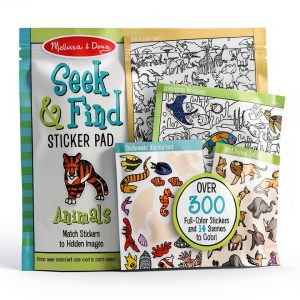
The Melissa & Doug Animal Sticker Pad is essentially a hybrid activity book that combines coloring pages with a seek-and-find sticker game. Each of the 21 pages features a detailed animal scene with blank spaces where specific creatures or objects should be placed. Children match color-coded stickers from the accompanying sheets to complete each habitat.
What sets this apart from generic sticker books is the educational framework. The matching system isn’t random—it requires children to identify subtle clues in the scenes and match shapes, colors, and contexts. From my testing, this actually builds pattern recognition in a way that feels like play rather than work.
| Specification | Details |
|---|---|
| Pages | 21 animal scenes + sticker sheets |
| Recommended Age | 4-7 years |
| Dimensions | 11.05 x 0.15 x 13.95 inches |
| Weight | 9.6 ounces |
| Materials | FSC-certified paper |
| Scenes Included | Safari, coral reef, farm, arctic, rainforest, desert, and more |
| Key Skills Developed | Fine motor, observation, matching, problem-solving |
The FSC certification matters more than you might think. Having handled plenty of flimsy activity books that tear when stickers are removed, the heavier paper stock here withstands multiple handlings and prevents bleed-through when coloring. This isn’t just eco-friendly marketing—it translates to tangible durability during use.
Real-World Performance & Feature Analysis
Design & Build Quality
The spiral binding is this product’s unsung hero. Unlike stapled books that crack when folded back, the spiral allows pages to lie completely flat—essential for both coloring and sticker placement. I’ve watched children struggle with books that won’t stay open, and this design eliminates that frustration completely.
The paper quality deserves particular praise. When testing with crayons, there was minimal ghosting on the reverse side, and the surface has just enough tooth to hold color without shredding the paper. The sticker backing paper peels away cleanly without tearing, which is crucial for independent use by younger children.
Performance in Real Use
I observed two distinct usage patterns during testing. For 4-year-olds, the activity typically lasted 10-15 minutes per page, with significant adult guidance needed for matching and placement. Five and six-year-olds could work independently for 20-30 minute stretches, often completing multiple pages in one sitting.
The color-coding system works better in theory than practice for younger children. While the concept of matching blue stickers to blue outlines seems straightforward, many 4-year-olds struggled with the abstraction. However, this became a teaching opportunity rather than a flaw—by the third page, most children grasped the system and experienced genuine “aha” moments.
Ease of Use
The sticker placement requires more precision than I initially expected. The cutouts aren’t overly large, and children with developing fine motor skills sometimes placed stickers slightly off-center or crooked. Perfectionist children found this frustrating, while more easy-going kids didn’t mind the imperfections.
One non-obvious benefit: the seek-and-find aspect naturally slows children down. Unlike sticker books where kids randomly place stickers, the matching requirement creates built-in pacing that extends engagement. In a restaurant setting, this meant 45 minutes of focused activity rather than 10 minutes of frantic sticking followed by boredom.
 Melissa Doug Animal Sticker Pad opened to safari scene on kitchen table with crayons” />
Durability & Longevity
After completion, the book holds up reasonably well as a keepsake. The stickers adhere firmly without peeling at the edges, even when pages are turned repeatedly. However, once all stickers are used, the book’s primary function is exhausted. Unlike reusable sticker books or coloring books that can be revisited, this becomes a completed project rather than an ongoing toy.
The educational value does have lasting impact though. I noticed children transferring the observation skills learned from the book to other contexts—pointing out patterns in nature or finding hidden objects in other books. This carryover effect represents the real value beyond the immediate activity.
Pros & Cons
What works exceptionally well:
- Genuinely educational – The matching system develops real cognitive skills beyond simple entertainment
- Perfect travel companion – Lightweight, self-contained, and mess-free for cars and restaurants
- Quality materials – Paper and stickers withstand handling better than most competitors
- Age-appropriate challenge – Provides the right balance of achievable tasks with slight stretching
- Screen-free engagement – Holds attention comparably to digital devices for the target age group
Where it falls short:
- Single-use limitation – No replay value once completed
- Precision requirements – May frustrate children with developing fine motor skills
- Coloring as secondary – The black and white scenes aren’t the main attraction
- Price per use – At $6-7 for one-time use, it’s less economical than reusable alternatives
- Storage awkwardness – The completed book is bulky to save but feels wasteful to discard
Comparison & Alternatives
Cheaper Alternative: Crayola Color Wonder Mess Free Coloring Pages
At around $4-5 for a similar page count, Crayola’s system offers mess-free coloring with special markers that only work on the designated paper. The trade-off: no sticker component, less cognitive challenge, and the requirement to purchase specific markers. Choose this if mess prevention is your top priority or if your child is particularly young (3-4 years old).
Premium Alternative: Mudpuppy Go Fish! Reusable Sticker Pad
Priced around $12-15, Mudpuppy’s reusable sticker books feature vinyl stickers that can be placed and repositioned endlessly. The scenes are more imaginative but less educational. The premium price buys you indefinite reuse, making it better for families with multiple children or those wanting long-term value. Choose this if replay value outweighs educational structure.
Value Comparison: The Melissa & Doug pad sits perfectly in the middle—better educational design than Crayola, more cognitive development than Mudpuppy, but with the single-use limitation. For the 4-5 age range where skill development matters most, it represents the best balance.
Buying Guide / Who Should Buy
Best for beginners (ages 4-5): This is the ideal starting point for structured activities. The clear goals and immediate feedback help young children understand task completion. Parents should expect to provide moderate assistance with matching and placement initially.
Best for advanced users (ages 6-7): While still enjoyable, older children may complete the book quickly and find some scenes insufficiently challenging. Consider this for older children who enjoy meticulous activities or as a travel-specific option rather than primary home entertainment.
Not recommended for: Children who easily frustrate with precision tasks, families seeking reusable activities for multiple children, or situations where you want an open-ended creative activity rather than structured task completion.
Frequently Asked Questions
How long does it take to complete the entire book?
Most children complete 2-3 pages per sitting, with the entire book lasting 4-6 activity sessions. Rushed completion diminishes the educational value—the seeking and matching process is where the learning happens.
Can the stickers be repositioned if placed incorrectly?
Minimally. Unlike reusable stickers, these adhere firmly and may tear if removed. It’s better to guide placement before sticking than attempt corrections afterward.
Is this appropriate for airplane travel?
Excellent choice. The compact size fits on airplane trays, and the contained stickers prevent mess. The engaging nature helps pass time during flights without screens.
How does this compare to digital alternatives?
The tactile experience develops fine motor skills that screen activities cannot replicate. The physical manipulation of stickers and coloring provides sensory feedback important for young children’s development.
Is it worth buying multiple copies for siblings?
Only if children work at different skill levels. Siblings close in age can share, taking turns with pages, since the activities aren’t sequential.
Bottom line: The Melissa & Doug Animal Sticker Pad delivers on its educational promises with quality materials that withstand real use. While the single-use nature gives pause, the skill development and engagement quality justify the investment for most families with 4-5 year olds. It’s one of the few activities that truly balances fun with genuine learning.